Daydreaming

The new project

Date is September 28, 2026…. yeah… feel better… but damn I am late…

So what is the new project that sent the “cruel puppy” to the back seat…
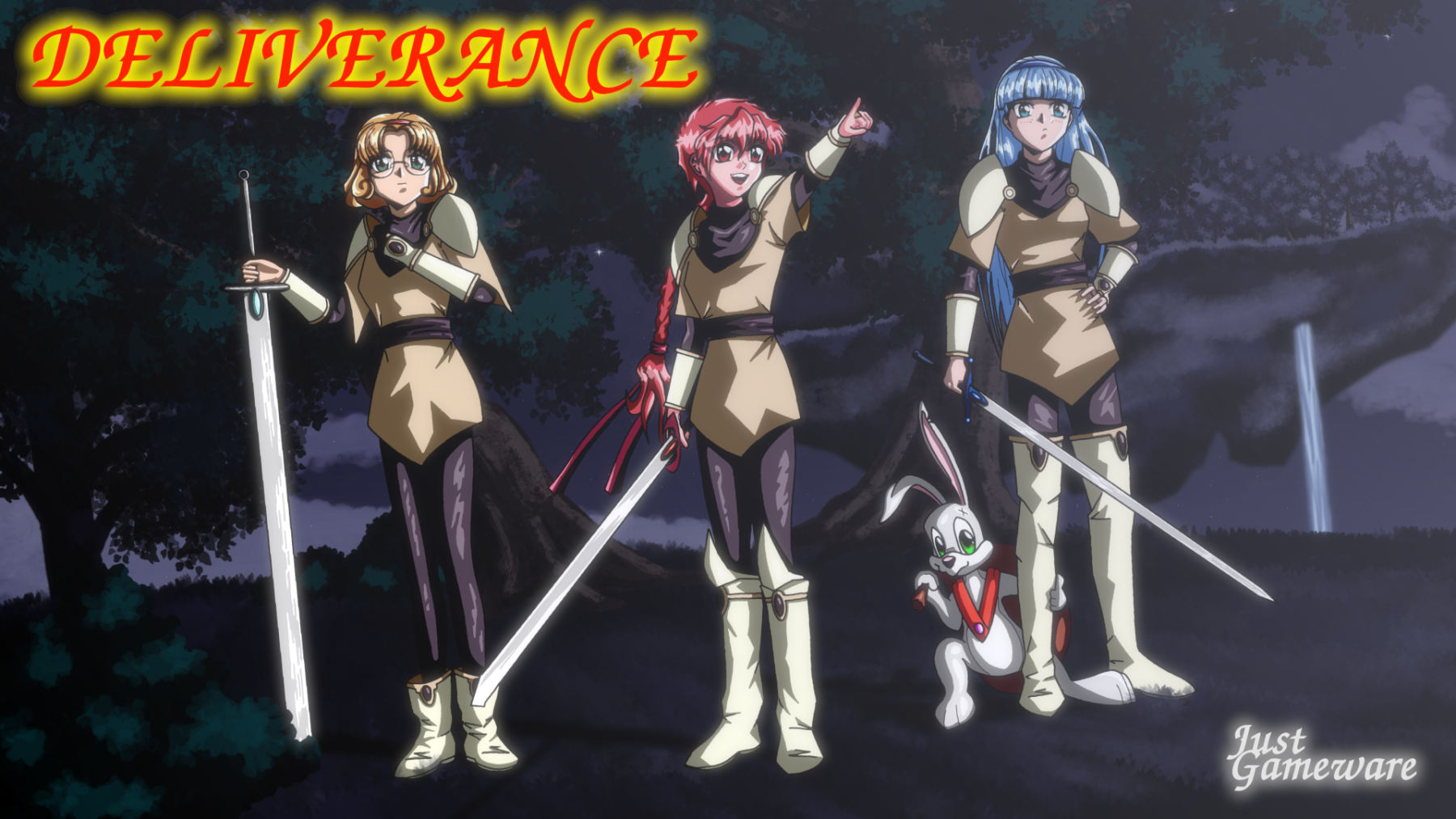
Title illustration…

Unexpectable, huh… well this is going to be one very long daydream…

Some may notice that this title illustration of mine really looks like one very old anime called “Magic Knight: Reyearth” (MKR), and they would be right, although I am not very happy because of that, but more on that later.

If I was trying to express the vibe of one key moment in those fascinating and unbelievable chain of events, I keep mentioning, in short, it would go like this:

Back in year of 2022, I wandered off in some old dusty archive, unfamiliar to me, with long forgotten files on various TV, gaming, etc. related stuff. Then started digging through it out of curiosity. It’s something I like to do (sort of like archaeology). Then once I was done and went toward the exit, from some nearby pile this cartoon fell before me, tripping me over to take a bath in the dust… After “What the hell?!” moment, I stood up, beat the dust out of me and picked package up from the floor, thinking “What is this…?”.

Yes, yes, while somewhat accurate, it was overall less atmospheric than this short description, but it fully captures my feelings on the matter. This turned out to be a final piece of the puzzle, I was looking for…

I will say right away that I am not fan of this cartoon. So this is not some fan related stuff. I was even reluctant to watch it, since I really didn’t want to watch anything at the time… but the whole package where someone went so far to prepare it with incredible care, then curious 13+ ESRB rating on the box art that the person scanned for the pack, and IMDB score (from the time when it actually meant something, I believe) convinced me to take a look.

The first impression was that the show was everything why I didn’t like anime even as kid. But… I also noticed right away something that will turn out to be a rather big — catch. It was “The Neverending Story” (TNES) type of plot or at least I recognized it as such, which was… surprising, particularly because I never saw important elements of that concept outside of the original movie. It’s not something from my childhood, so no rose glasses here, actually I don’t remember ever watching it as child, but a number of years ago I did watch this movie and found it… interesting in several ways. And now this anime was borrowing important elements of that plot. Thus, I got curious to find out where the authors were going with that.

Overall core plot of the first part wasn’t actually bad, but it was totally ruined on operational level, sometimes so typical for Japanese… I mean, who the hell though that the mechs make sense in the story like that to begin with. Because of them I couldn’t even appreciate otherwise conceptually nice ending of the first part (solid twist and all)… frankly, it was just stupid with mechs.

Then I proceeded to the second part. And well… it was even worse. BUT with just as much, even better — catch. If in the first part I recognized TNES, in the second part I saw… “Planescape: Torment” (PST). Now that was one good WTF moment! Of all things, this was maybe the last place where I was going to expect that narrative. For the record, PST is one of mine all time favorite stories (wish I could say the same for the game as whole). So naturally I got very interested to see where they were now going with that, tolerating vast amount of all kind of stuff that was stupid to me. For a long time I considered PST story unique and original, but considering that MKR is five years older than PST itself, it also got me wondering… Anyway, the wrap up of PST element in the plot was solid.

So in the end I asked myself, what did I actually watch? Something that resembles to me TNES + PST. An odd combination, or so I thought at first. Then soon I realized that the reason why I found it odd was probably because TNES was story aimed for kids, while PST was story aimed for (very) mature audience. Stories are in fact kindred, as they share the same genre of dark fantasy and both have trouble of philosophical nature in their foundation, with blind search and decay as main motives.

Prior to some years I was searching for a type of plot that relied purely on my imagination gone wild. Realism, science and particularly physics, be damned. Something where I could write and especially design whatever was on my mind at the moment, and where only requirement was, that it was “cool” (whatever that truly means). Soon I realized I would end up with something weird as “Alice in Wonderland” or works of David Lynch (as a kid I used to say — one day I’ll beat this guy in senselessness, ha!). This cartoon reminded me however on something notably less abstract but still abstract enough and that would be TNES. Plus, MKR did upgrade the concept of TNES with some good ideas (…that then they barely put to use…) like “monsters being fears of people”, which is particularly good for an arcade aspect of the game. As designer, it gives me free hands to spawn whatever monster I want, wherever I want, at whatever time I want, in however number I need and I don’t have to justify anything in the plot.

Overall, MKR did very little with such a good idea of TNES + PST (well, latter didn’t even exist at the time). So I decided to claim it for myself. I wish I came up with this idea myself, but I didn’t, and I am not gonna pretend that it is (fully) mine, as I consider it really lame when someone does that. Also, the cartoon was from 1994, so 30 years old and somewhat forgotten which is very good as I wouldn’t like to deal with the fresh baggage especially if it was popular, in this context. Thus I asked myself, what happens if in a hypothetical plot of mine according to that idea, I combine… more serious TNES with less serious PST (after all, heavy metaphysical philosophy isn’t really for a cartoony game I have in mind)? …Something rather fascinating, I’d say.

Starting from here, I’m gonna break monotony of all this text with the illustrations. All of them I designed as screenshots taken from hypothetical ongoing in-game cutscenes. Unpredictable in-game cutscenes in form of quality animated movie are meant to be important aspect of this game’s design. Where “unpredictable” means that player can expect cutscene to trigger at any moment during the game, not just where those are usually expected (intro, end of chapters, outro, etc.), which I consider a piece of good game design.
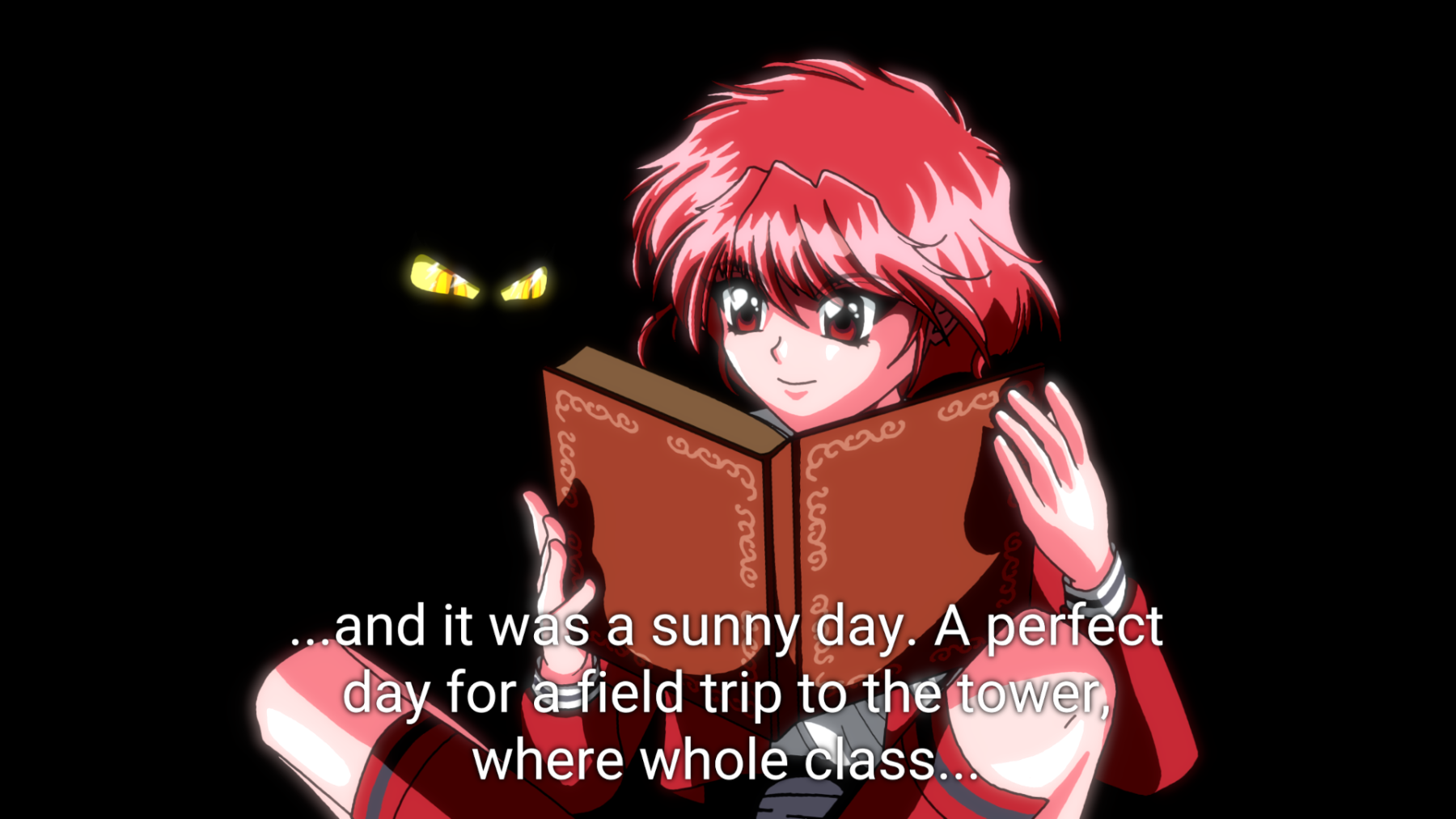
Somewhere near the end of the cutscene that is supposed to be played after new game has begun. After some chat with her company, the girl has begun reading the mysterious book that she was given…

Coming up with how I wanted game to look like and all the needed code for it, were an easy part. It was like a perfect storm. I already had a bunch of gameplay mechanics that I came up with in the past, which I have never seen in any game, so those made me itchy to try them somewhere, but never found the correct context. Such as, special melee combat mechanics and what I call advanced tag team mechanics. This was perfect opportunity to try those and overall opportunity to build the game in one of my top favorite game genres, which would be… eh… lets call it arcade-adventure (I have my own word for it, based on one old game magazine); where arcade part this time is classic platform game, and adventure part with P&C adventure game-grade puzzles, the ones that can seriously stuck player and make him lose up his mind or give up and peak into the walkthrough, and therefore — cheat. And regarding code, thanks to Godot, most if not all code requirements are in domain of my coding skills. Really haven’t had any major issues so far with the code and hopefully it will remain that way.
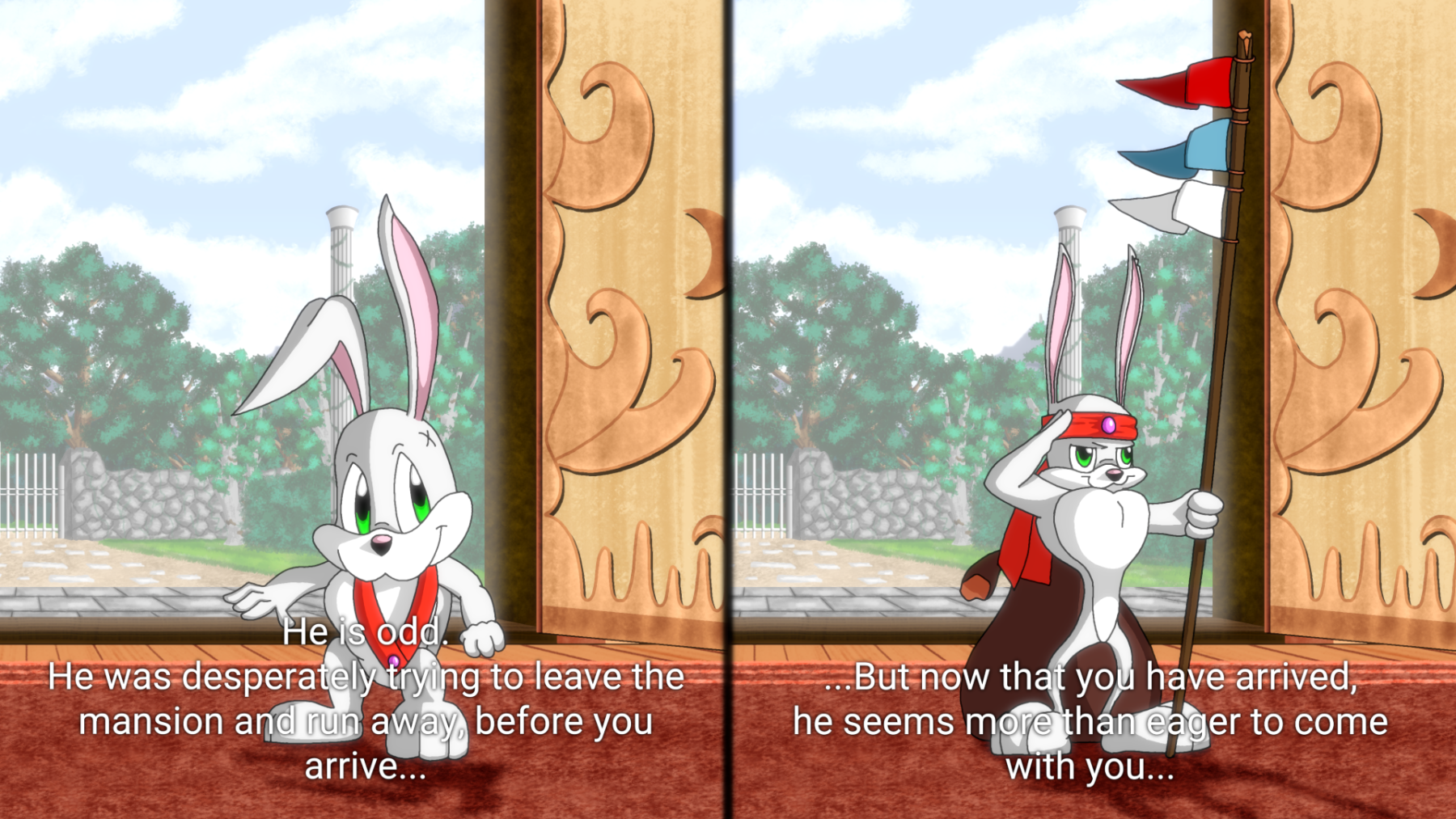
The main sidekick and comic relief character that I refer to as Wayfarer (Toon9999), the word for specific type of creatures in the lore of the setting. That original creature that one can’t resist but to kick out of the cadre (fine, fine, I’m being rude, cruel and disrespectful, I know…), is replaced with my own– eh? …Okay, I admit that I snatched one of Dean Dodrill’s rabbits. He drew so many of them so I doubt he would miss one. In fact, I modeled him upon the image of Jazz Jackrabbit which initially isn’t Dodrill’s. This character is sort of walking inventory among many other things (from which he certainly — cannot — pull out a whole damn apartment! Jeez…), like Rincewind’s walking trunk, but less courageous, which means that player’s inventory can run away. And he’s also in charge of bright moments… Still thinking that he should be goofier on this image, but this is my current reach in this art style, so there’s that…

Then came good ol’ king of the problems — graphics. Add to that my ambition of Don Bluth quality of animation and yep, everything looked totally impossible. However, I once made a grave mistake believing that something about game development is impossible for me. Namely, coding, yet as a total miracle that problem completely solved itself with engines like Unity or even better Godot. Who would say that all I actually needed to do was to patiently wait for Godot to arrive (in-your-faces, Vladimir and Estragon!). So in spirit of “I ain’t gonna repeat that mistake again!”, started pushing ahead, according with my full vision, with hope that a new miracle related to the problem with graphics will catch-up with me somewhere on the road, so… que sera, sera.

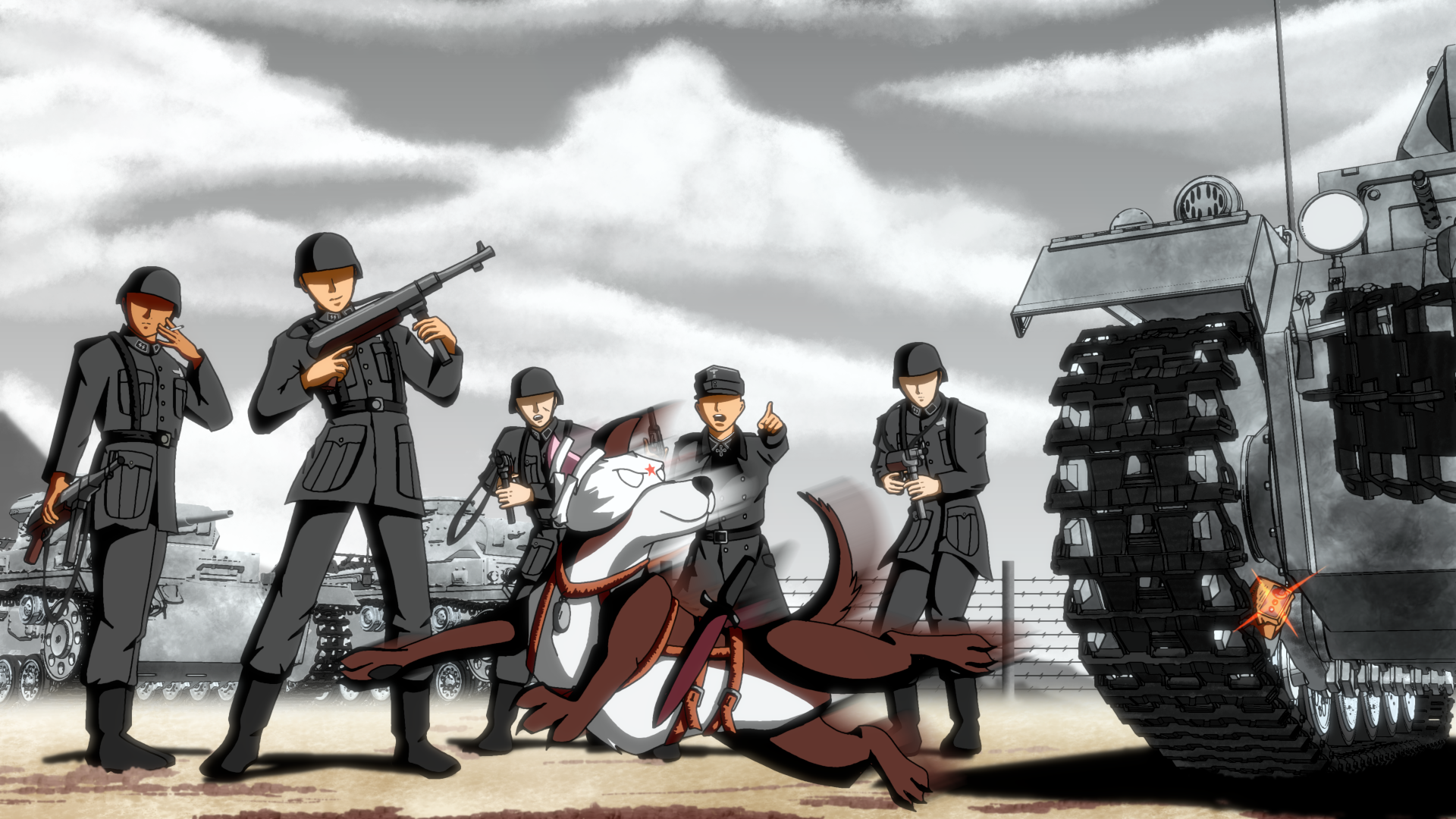
At first I was thinking to change all the characters but quickly got hard lesson in that my fresh art skills are not really on the level of (serious) concept art… On the other hand I discovered a treasure throw of all production sketches from the MKR series and also an old Sega Saturn game, full of additional useful graphic stuff. In other words, plenty of material to work with, and tangibly ease the “impossible” part, if I only give up on changing characters. Anyway, since cartoon is old enough and dormant, and since Red, Blue and Green, as traditional archetypes, also fit very good in my vision too, along with some other characters, I decided to keep them… at least for now. That’s the reason why I refer to them as Red, Blue and Green (although I’ll change her identifying color to White), or Toon0001, Toon0002 and Toon0003 in the game code. Since I don’t know if I am truly going to keep them or not, for whatever reason that may come up, I’m avoiding using their names as names tend to get under the skin and form a habit that is later annoying to break. I’m also keeping the Red’s dog (or Toon0004) who is going to have quite a role and conveniently will also be of use to me in learning how to draw and animate that other WW2 dog. In general, keeping some characters I also see as a token of respect to original authors for giving me this idea.
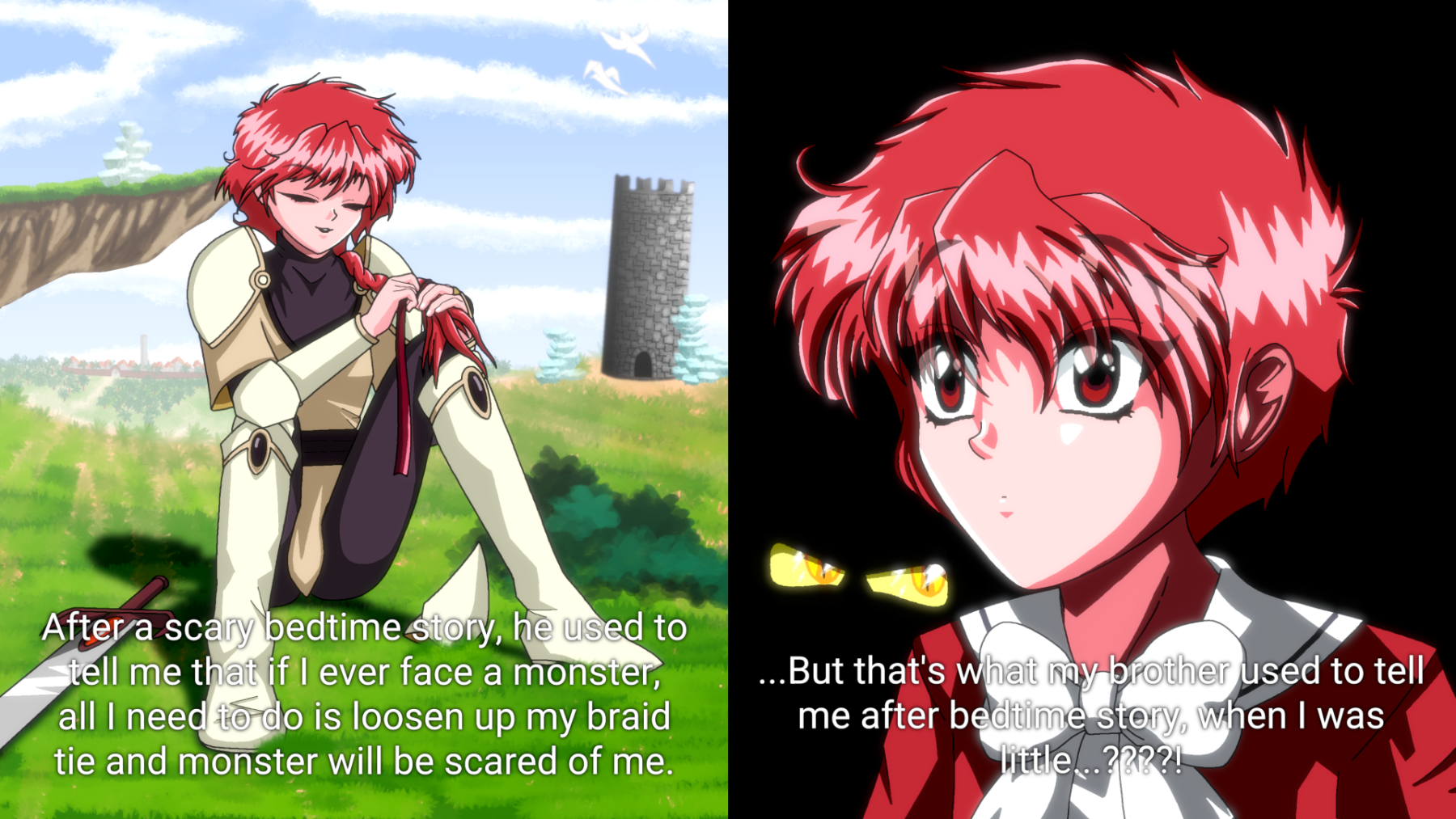
After the rest is selected at some point (yep, there’s resting mechanics in the game), on the following pages in the book that describe the chat between the character during the rest, Red finds out that one of them is talking about something so very personal to her. And starts getting the feeling that one of the main protagonists in the book, is scary similar to her.

When it comes to the plot, what I am going to keep from TNES is two-layered narrative that is going in parallel. One layer is the Red reading the mysterious book and the other layer is actual events in the story she reads, and where the game takes the place. There are multiple benefits of this two-layer narrative for story-writing. For example, it’s good for offsetting some of the cringe that is sometimes inevitable to happen. Apart from that I’m also keeping plot’s core motive of MKR in the first chapter, as well as some locations in the setting. Most of narrative, geography and lore should be of my own imagination, which, apart from TNES and PST, is primarily guided with classics like Loom, Shadow of the Beast, The Longest Journey, Excalibur and various other non-Tolkin fantasy (that doesn’t fit in this setting).

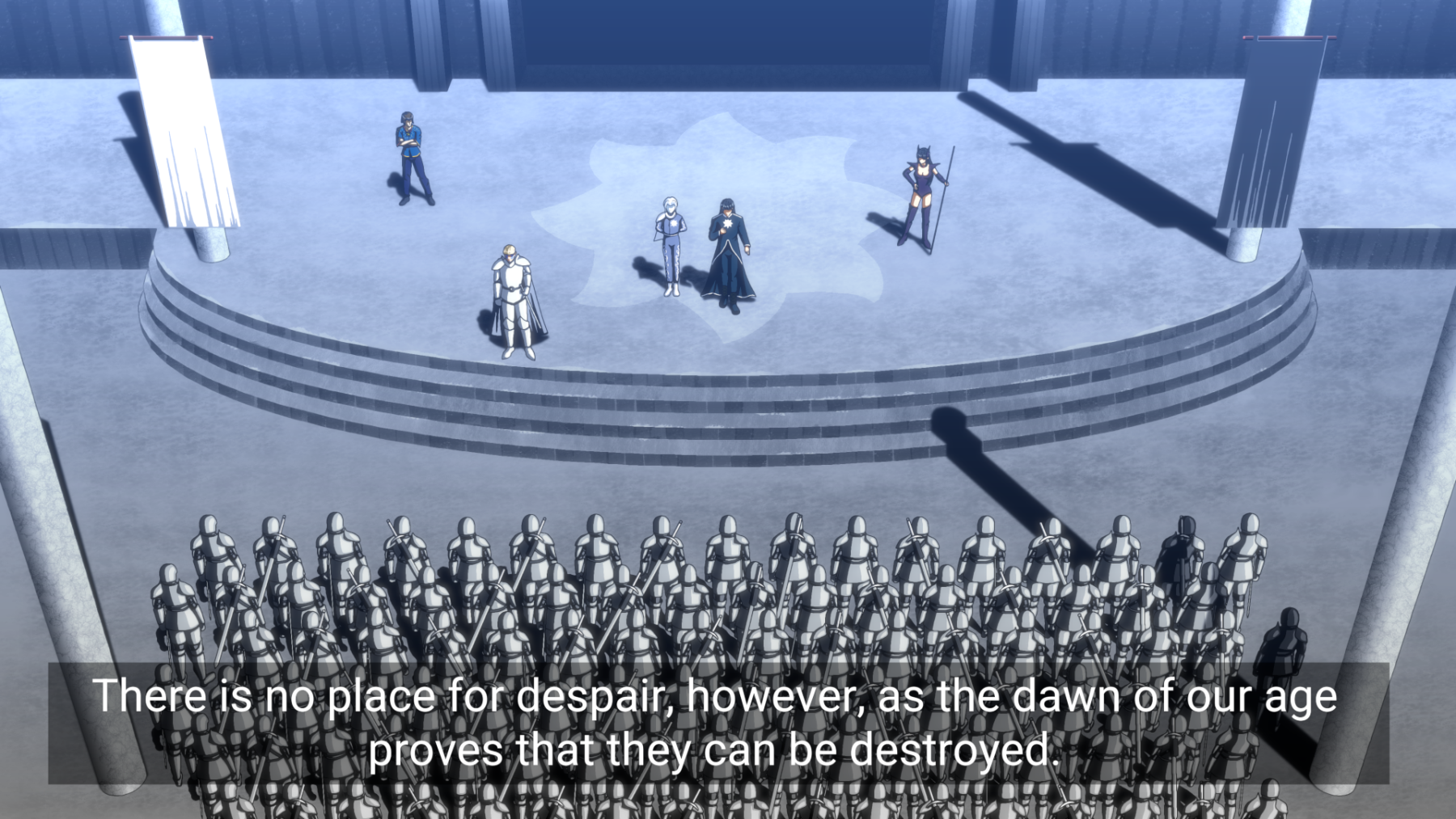
Again somewhere at the beginning of the story. There it is a sort of a summit of enemies to main characters. For the context, at the beginning of the story, the main adversary knows only that the three are summoned, he, however, doesn’t know where they are or even how they look like. The large army are actually called “Thousand Sentinels” and while their number suggests that they are some sort of a “trash mob”, in fact each one of those men (and sandmen) is nearly boss-grade adversary. It is my devious intention that whenever player run into one of them, become very sour… but it remains to be seen how good I can pull that out. So far I made only one hostile creature and its AI.

“Deliverance” is the working title of the project, but I grew fond of it in the past years and will probably keep it as part of the title. This word has that just right foreboding, eerie feeling to it.

All in all, in the last three years I made much of the game and nearly closed the base construction, just not combat mechanics, which is rather big “just”… Tedious thing is that I actually laid foundations even for combat in the code, but now everything depends on sprite animations and that’s… not gonna be naive at all… so once again graphics are serious trouble for my progress…
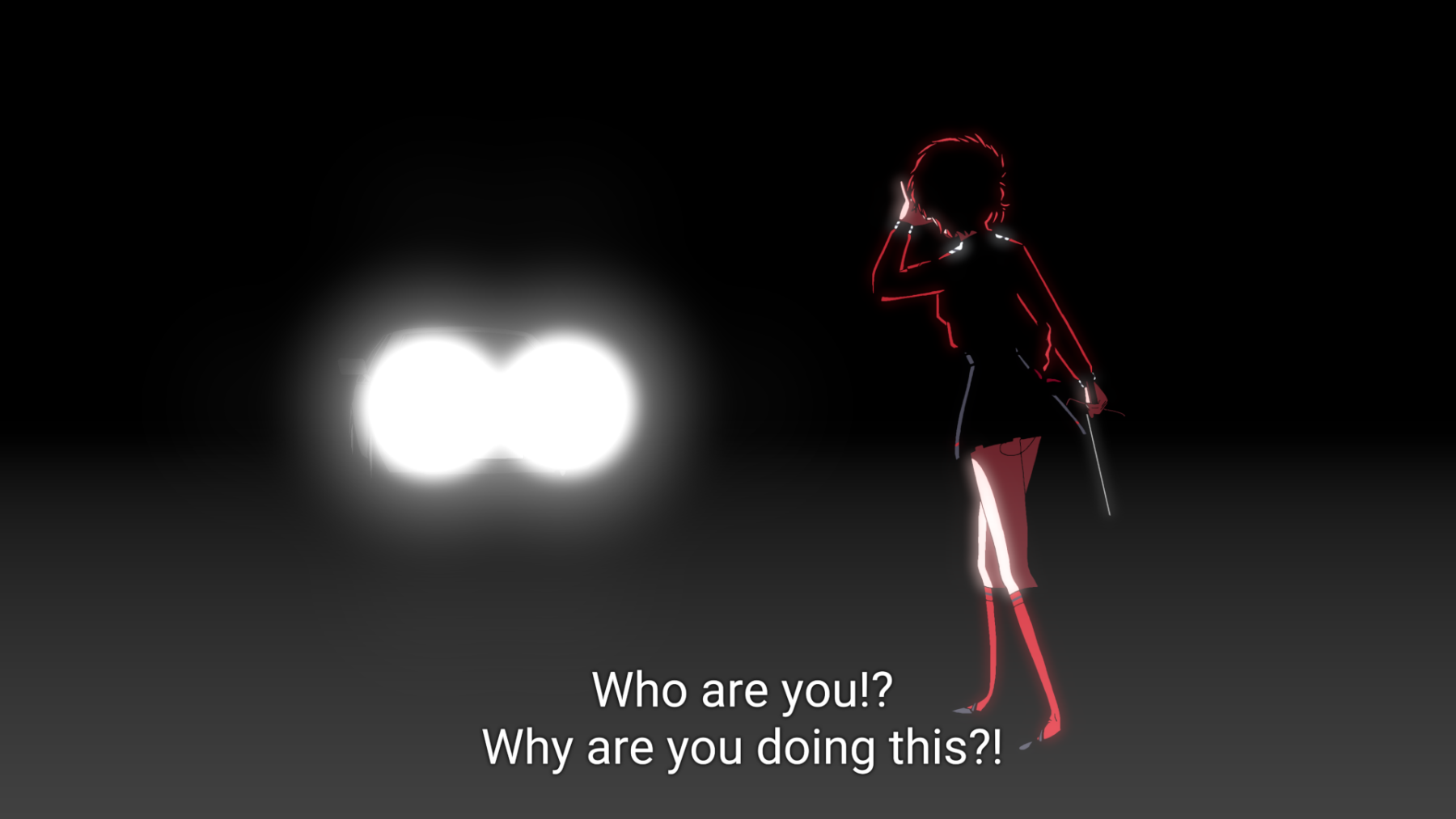
Here we have– well, anything I write would be somewhat of a spoiler, so I’ll leave it at that. I do need different model of the car though, but I don’t know yet which model is the one that follows my exact vision for this car, as I am not into cars myself…

Main control scheme is mouse and keyboard. Due to combat mechanics and adventure part, it is unlikely that it can be played with joypad. As for game’s difficulty, I am definitely not going to nanny the player in any way. I in particularly don’t like selection of difficulty level that nearly all games have. I consider it a cheap way for game designer to “wash his hands”. A true game designer with true dignity sets the difficulty according to the inner feel and takes full responsibility for it. “Rayman 1” is probably one of the brightest examples of this, in platform genre.

And last but not least, this (as well as that commando dog) is supposed to be an open-source game. Yeah, that’s right, developed using open-source tools (and non-open ones if I really have no choice, but then firmly quarantined to prevent them to let their tentacles into development ecosystem and taint it). So far those have been primarily Godot, Gimp, Krita and above all else Linux of course, accompanied with Linux friendly hardware. However, I’ll keep everything for myself for now. Like I mentioned before, I didn’t even want to come out with all this, but certain ugly turn of events forced me to…

With that said, I am two more illustrations away from closing this composition of images, where I just wasn’t able to do them in time, and I am already very late… so, I will keep them for the next daydream on this topic…
On the road to new project

Today is September 24, 2026. Feeling a bit better just by writing this…

Ever since the problem with coding was solved for me, in a way that I can now not only do high-level coding (or scripting which would be better term) but mid-level coding too, allowing me to build myself necessary tools for scripting, thanks to Unity and now Godot, the new “king of the problems” became — graphics. And that left me once again in trouble, since none of my other ideas could contain gathered graphics as Limit Load could. Cool, no? You put incredible amount of effort to jump over one wall, only to crash your nose in the next one right behind it. Life, I guess. In other words, all ideas of mine are pure creation of my own imagination so I won’t find graphics on internet for them.

But after series of fascinating and completely unbelievable events, where I also met Godot among other things (those guys were futilely waiting for him in classic drama, but mine seems like it has actually arrived…), I was, lets say — very — encouraged to learn to make graphics from the scratch myself, particularly stylized graphics aka cartoony one, as my most developed game idea was centered around cartoony 2D arcade game. Thus I went on learning to draw in that particular style. Fun fact is that by going in that direction, I soon got aware that anime had completely conquered world of traditional 2D animation and from what I could see during studies, I gotta say, fair and square. It’s almost touching with how much love and care are anime techniques documented and explained for that semi-realistic category of drawing I was pursuing (real human proportions, impression of real scenery and such), so no wonder its everywhere….

As a small kid who was avid fan of cartoons, before getting into gaming, I considered Don Bluth’s animation as topmost quality animation (which probably still is). Later my idea was that I eventually make 2D game in cartoony style; in that Don Bluth’s animation style (but certainly not gameplay!)

And then somewhere during Limit Load development, I came up with this idea…

Basically this is story and setting inspired by an actual WW2 element. Russians did use trained dogs in fight with Nazis and I got this whole idea after I found out that they didn’t use dogs as cannon fodder, but rather trained them to do the job and try to get back alive. And that the job was usually about planting explosive.

https://learning-history.com/soviet-anti-tank-dogs

(German shepherds??! That explains the setbacks then; yeah right, they mixed up the soviet and nazi diesel… they were lying like dogs! They knew well who was who but didn’t want to go against countrymen! Anyway, I am not changing my stance; mine’s gonna be a bum, picked from the streets. Once he goes against real royal german shepherds — that do not pretend for who they work for — it will capture well the essence of the class struggle! …Ahem)

So this is supposed to be an action game where main protagonist is one such exceptional dog; going on, doing usual commando business. But then I had some hardship in unfolding this idea further. For start, I am not really fan of WW2 setting, thus I was thinking going also beyond WW2, where this dog would be harassing operations like famous “Operation Paperclip” or maybe go into altered WW2 setting. And then there was a question of how was this dog going to fight in 2D arcade game. For example, using his jaws is somehow too primitive, but then how to use that NR-40 to go Blaskowitz on his opponents (okay, not THAT gruesome!)? Some pictures of soviet dogs on the web capture somewhat pretty well what’s on my mind at the moment, regarding this element :)

Anyway there were various questions that I was slowly unfolding, expecting that I would soon start making this game, but then, in the last moment, during that series of fascinating and unbelievable events, this idea went on the back seat for now…

Some catch-up about Limit Load…

Okay, I am going to post several daydreams in the coming days. Not exactly something I would normally do, but recent development of certain highly unexpected and unwanted events kinda forced my hand.

But before all that, I’ll say a few words regarding that old Limit Load project.

I was way deep in one of those three campaigns, Broken Star, the day I first announced Limit Load back in 2015, and wrapped it up later that year. I was often joking with myself and the code guy that I was gonna beat Wings in amount of mission, but I ended up with ~80 (if I remember well). Not that bad, considering that many of those missions were far more complex and longer compared to any mission in Wings, with many dialogues and cutscenes thrown in-between, so overall length of the campaign was somewhat closer, I think. My design choice was to mix Strike Commander type of missions with Wings type of missions. Meaning, after some of those long, exhausting missions — where player first takes-off, then goes to several areas, completes objectives (or not), and then returns home to land — I throw one or more Wings-like mission(s) next. Pure instant-action, where player starts in the air already and have a fixed amount of aircraft waves to shotdown before mission is automatically ended. To shake up the chore and vent possible monotony that complex missions may have pilled up. Although even for those instant-action missions, I often couldn’t resist but to fill with bits of story narrative and directed cutscenes during the mission itself, despite mentally curbing myself all the time. (“Stop it! This is supposed to be a pure gameplay action mission, enough with dragging dialogues and movie stuff already!”). By the way, for failing the missions, I actually created the consequences. One primary, of automatic type, and one secondary, similar to those from first Wing Commander and known “Meanwhile” cutscenes. That is, I made groups of missions that were part of thematic wholes inside the main story, so the ending of those parts of the main story was depending on successes in completing missions during those wholes, accompanied with “Meanwhile” cutscenes at the end.

For Limit Load I built/gathered all the necessary elements (graphic, audio, screenplay, etc.) and put them in composition. Creating composition out of elements is my thing (which I think is called — design); making each of those individual elements isn’t my thing though… or rather, it varies how good I can make them in a reasonable amount of time (graphics being the biggest problem of all). However, logistics like version control, systems to deal with insane amount of game files, system of patching, system to distribute all that, etc. and the game’s infrastructure like menus with options or ability to skip the cutscenes and such, were on the code guy to build and maintain. Logistics really isn’t my thing at all and I easily get lost and then get very irritated by it. So without that necessary logistics/infrastructure, the campaign was left in the dark, as were all the models I built for the campaign, audio and story/screenplay and overall design of any kind. When it comes to the graphics, the most important models, like jets, I made available on game’s website, but everything else, particularly source files, were in total organizational chaos and several gigabytes big. No matter how hard I was trying to keep them organized, files just kept pilling up and up and up, at frightening pace, during development.

Since the code guy never had a chance to get back to it, the whole project was left in limbo… but he might return to it some day though. I definitely finished my part. (Although I would really prefer that the whole scenario is examined by a pro book-editor, or at least a well-versed geek, before it ever sets its foot in public. As I am not exactly an expert writer, and not even versed in air force jargon, with exciting sentence constructions, in pop-cultural political techno-thriller story, which Broken Star somewhat is…)

That’s it about the past, now onto new stuff, all related to the Godot engine…

Four famous amongst the modern jet fighters for Unity

Package of four jet fighter 3D models is published in Unity Asset Store!

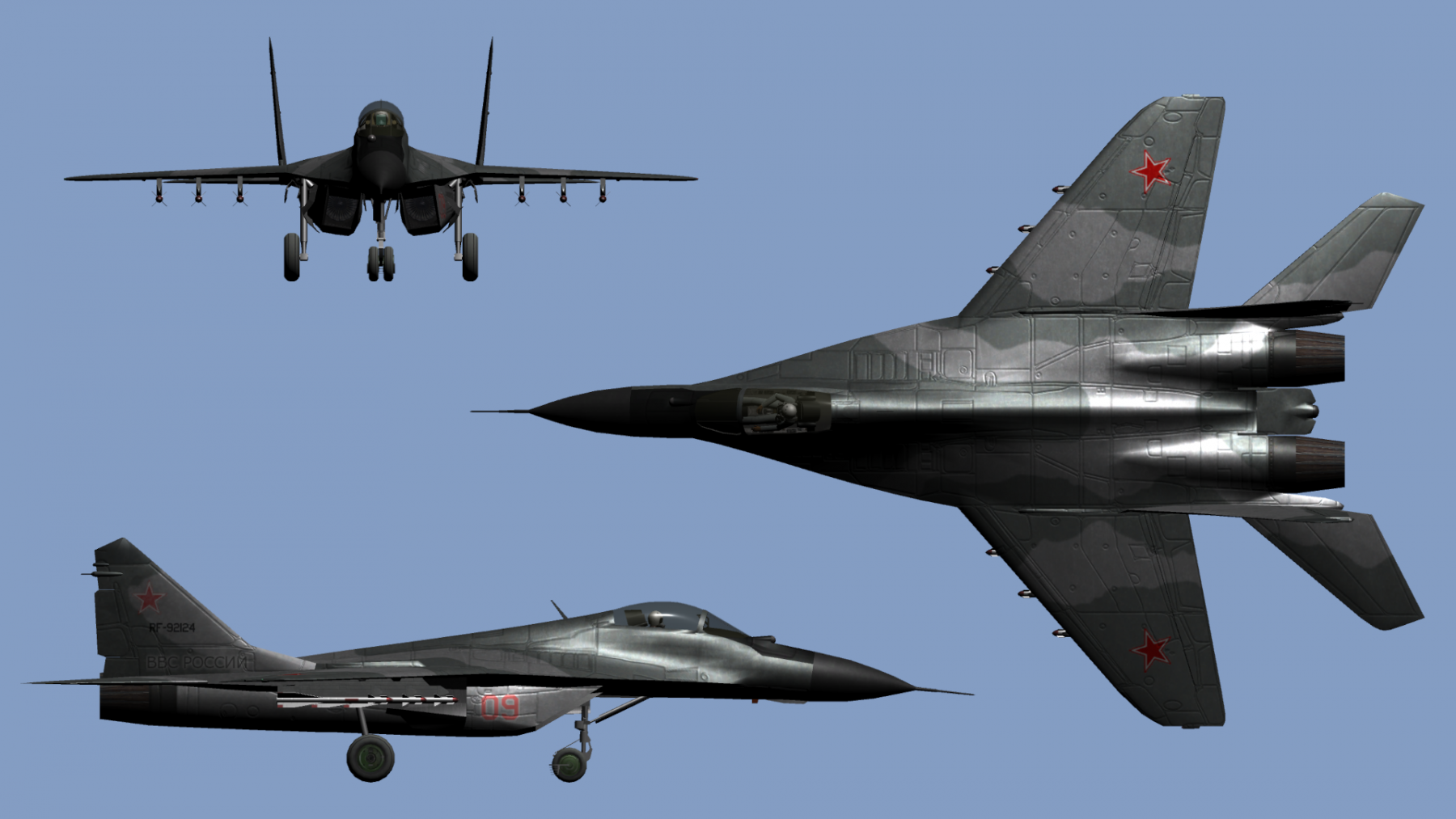
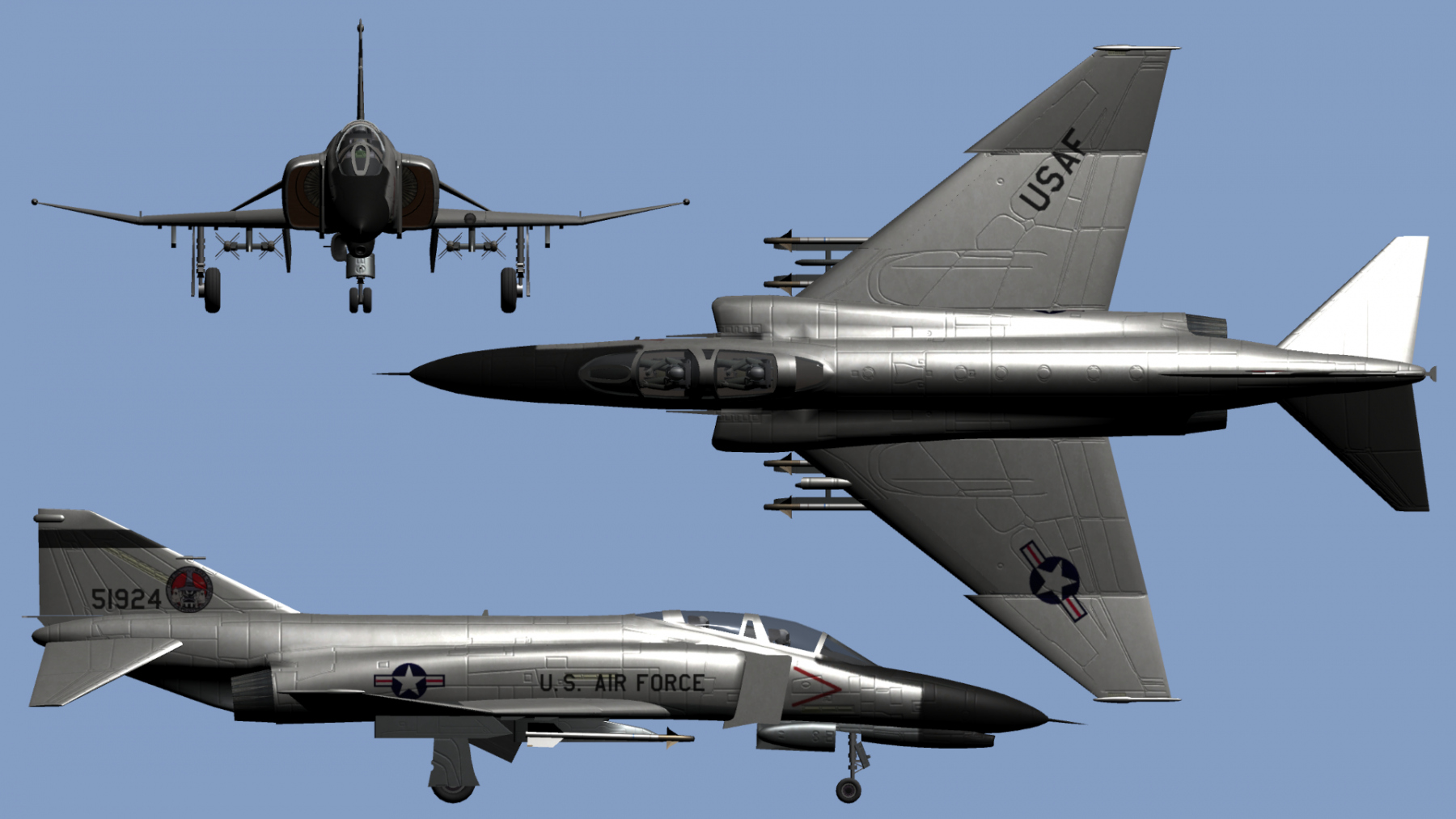
It is a package of four famous modern jet fighters, made above all for arcade and semi-realistic games, like Limit Load. These four jets, MiG-21, MiG-29, F-4E and F-16, are very similar to their counterparts that are used in Limit Load. However jets are built from scratch, according to real blueprints, in order for some errors to be fixed here and there, as well as to avoid any potential problem with licences. Only MiG-29 is inspired directly by the model from Limit Load, which served as the role-model and also as model for Blender-learning many years ago.

Of significant help in building these jets, were two 3D artists:

Leo Jones (MIG-21, F-4E)
Michael Colina “Michael Ben David” (F-16)

Somewhat unexpected, making these jets was quite difficult venture, but hopefully more packages will follows :)

Advanced Invaders 1.5 for Android

New 1.5 version of Advanced Invaders for Android is available.

This new version is built on the latest most stable version of Unity, and this release is mostly about some Android compatibility maintenance required by Google Play store.

Advanced Invaders 1.4 for Android

New version of Advanced Invaders for Android is available at Google Play. In this release:

  • No more support for x86 architecture
  • Minor optimizations

Since Unity has dropped x86 support for Android and Google requires now that all supported architectures have 64-bit support, as of this version of the game, there will be no more support for x86 architecture for Android. This has decreased overall size of game package APK. Other than that, game has been built on the latest version of Unity which gave opportunity for some additional minor optimization.

Binary Void Version 1.3

Binary Void version 1.3 is available in Unity asset store:

  • PDF walkthrough is updated with additional explanations and advices
  • Added more code comments
  • Minor code polish

The walkthrough is now 93 pages long. Some sections are updated to provide better explanations and a new one is added. This new section is about building the project into the game and it offers some tips for optimizing the build.

Advanced Invaders Version 1.3 & Binary Void Version 1.2

New Unity 2019 gave a nice performance boost to Android version of Advanced Invaders, thus the game is updated to version 1.3 on all platforms:

  • Performance improvements for Android version
  • ARM64 support added for Android version
  • Added Android adaptive icon
  • Alien bomber yields more points
  • Some additional minor polish

Particularly in Spacewatch mode, when bullet hell occurs, frame-rate could notably dip down. Now it appears to be solid ~60 in my testing on the same device.

Also, sooner than expected, an update to version 1.2 for Binary Void is available:

  • Fixed a problem where if project was built as a game for Android in Unity 2018/2019, virtual joypad axis wouldn’t detect dragging input event across the touchscreen
  • Added more code comments

Problem about joypad axis was really annoying one. In Unity 2018/2019, the virtual joypad axis in Android build of the game, was still functional but without drag events, which means it wouldn’t follow the finger-drag across the touchscreen and inside the axis field, making the use of it rather clunky. Turns out that the culprit was this line of code:

Cursor.lockState = CursorLockMode.Locked;

This code is basically locking the mouse cursor, but as of Unity 2018/2019 it seems to also disable drag detection on the touchscreen (at least for Unity’s UI system). Not sure if this is a bug in newer versions of Unity or intentional “fix” (make somewhat sense to be considered as such), but it sure gave me a headache.

Also, a forum topic about Binary Void has been opened in learning section of Unity boards, and you are invited to visit it :)

Binary Void Q&A Thread

Binary Void Version 1.1

New version of Binary Void project is available:

  • Fixed compatibility with new Unity 2019
  • Updated PDF walkthrough with more polish and additional explanations and advices
  • Updated some code comments, in order to be more accurate

Note from experience that could be useful to someone. When importing some project (with project settings), in Unity 2019 from some earlier version (like Unity 2017), you might have, Scripting Runtime Version set at Stable (.NET 3.5 Equivalent) option, in Project Settings/Player/Other Settings. This option is declared deprecated as of Unity 2018, and while in Unity 2018 project could still work fine with this option set, in Unity 2019 number of compiler errors might appear, making project broken right from the start, until the switch to .NET 4.x Equivalent option is made.

Binary Void, an expansion of Advanced Invaders! Sort of…

Binary Void has been published on Unity asset store!

This full game project is derived from Advanced Invaders and it’s carefully crafted for the purpose of teaching the general principles of game development in Unity. It features over 6800 lines of organized and commented C# code, and it comes with 90-pages long walkthrough documentation that is covering other assets as well, beside the code. The game itself may be 2D arcade (and of well known type) but it contains a lot of elements useful for many types of games as well as that general structure that most games of whatever genre often have (like saving stuff in files on disk or tweaking various game settings, rebinding of controls and such). While I was making Advanced Invaders, I insisted on building all this in order to learn how to make this structure for future games. Binary Void is the type of example project I wish I had when I was making my first steps in Unity so I figured I could make one myself. It’s long straight-to-the-point practical example that one can experiment with. I got impression that tutorial game examples in general, are all made with idea to push rookie developer straight into the gameplay action, neglecting essential structure that often needs to accompany the game and which is often quite tricky to build (at least it was quite tricky for me).

Nearly everything that Advanced Invaders game offers, is part of Binary Void as well. You can find out more at Advanced Invader’s page.

Based on what I read about publishing on asset store, I would say Unity folks aren’t joking. For example, this project needed to pass these guidelines:

Submission Guidelines

I checked them carefully and then adapted all elements of the project to meet these required standards. The fact that Binary Void passed on the first try after six days of waiting… I wonder if I should think of it as achievement :P Or was all that just a tall talk…

Otherwise, in the meantime, I have been toying with other aspects of Unity and as some of unity folks said, there really isn’t much difference between 2D and 3D in Unity, although it could be that my experience in Limit Load is talking here as well. I honestly feel now that Panda3D is like a spartan 3D engine considering how easy and approachable it is to build some graphical moments in Unity, which I consider essential for achieve the “good enough” 3D visuals :)